
Why We Don't Just Read the Codes — What an Oscilloscope Shows That a Scanner Can't
A fault code records that a system detected a problem. It does not identify what caused it. Here is how oscilloscope analysis gives Shaw's more information than code reading alone.
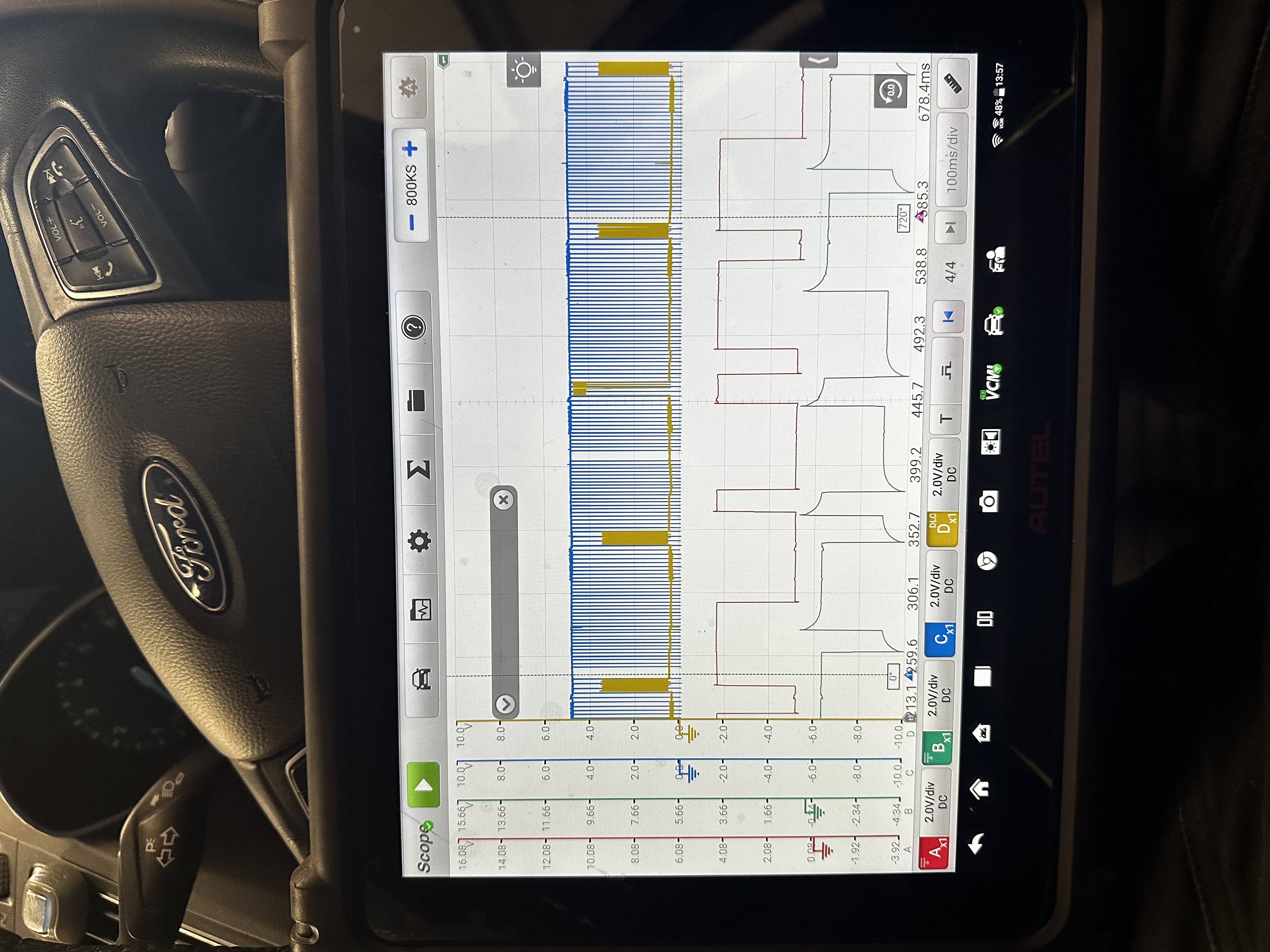
Code readers are widely available. Inexpensive plug-in devices, smartphone adapters, high street parts stores — most of them will read fault codes stored in a vehicle's control systems and display the associated description.
This information is useful. But it is a starting point, not a diagnosis.
What a fault code actually tells you
A fault code is a record that a control system — the engine management unit, the gearbox controller, the ABS module — has detected a value or signal outside its expected parameters. The code records the symptom or the trigger, not the cause.
A code that reads "Crankshaft Position Sensor — Signal Implausible" does not confirm that the crankshaft position sensor needs replacing. It records that the engine management system received a signal from that circuit that did not match what it expected. The cause might be the sensor itself. Or it might be a wiring fault. An intermittent connection. A reluctor ring with a damaged tooth. A wiring loom routed too close to a heat source. Electrical interference from a failed shield.
Replacing the sensor because the code names it is sometimes correct. It is also sometimes a coincidence — the sensor gets replaced and the underlying cause remains.
What an oscilloscope shows
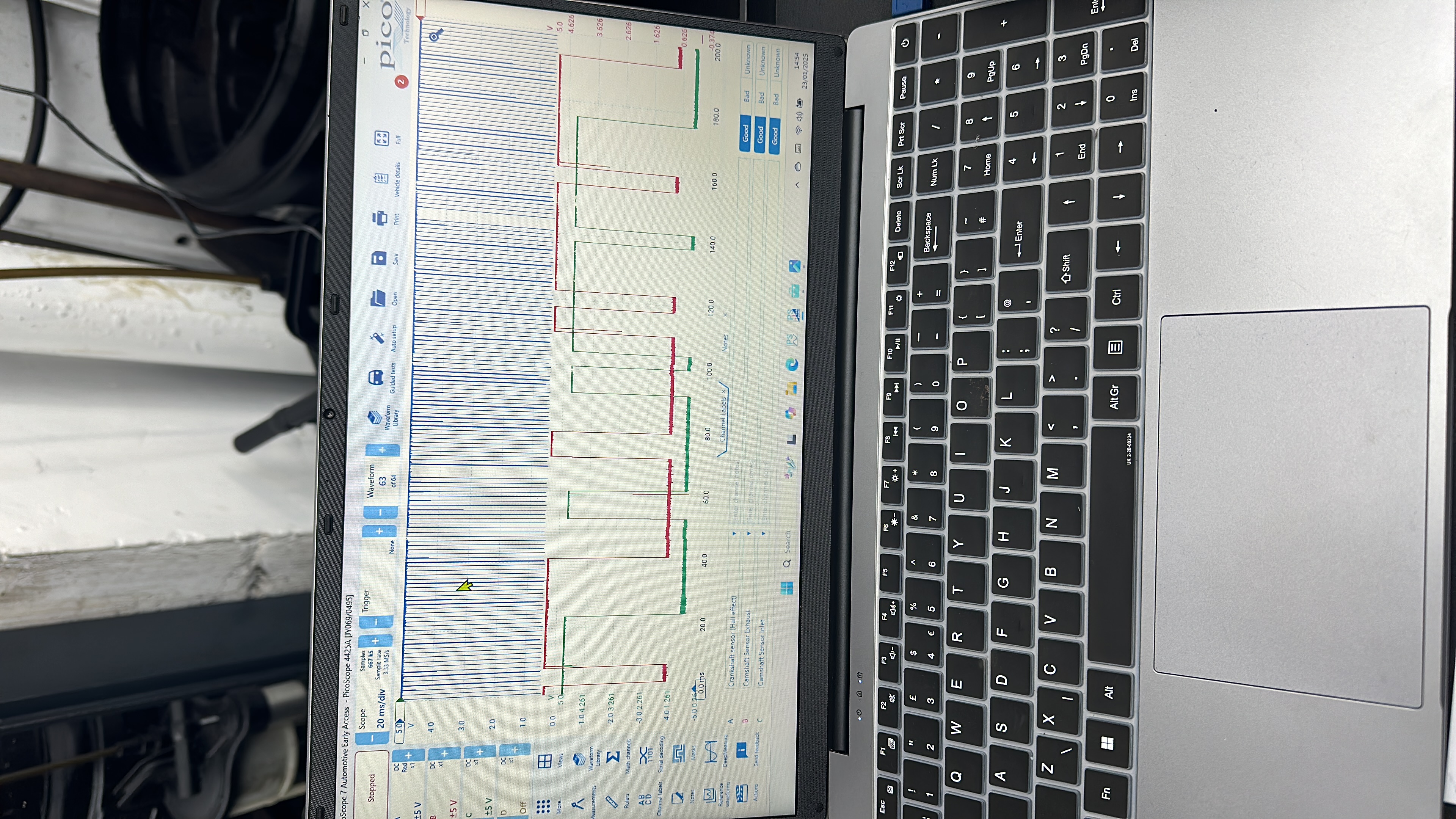
PicoScope 7 Automotive software showing live waveforms from the crankshaft position sensor (Hall effect) and both camshaft sensors simultaneously. Each signal can be examined in detail — its pattern, consistency, timing relationship with the other sensors, and whether it degrades under specific conditions.
An oscilloscope connects directly to a circuit and measures the actual electrical signal in real time — not a stored fault code after the event, but the live voltage output as the engine is running.
For engine sensors, this means seeing the actual waveform the sensor produces with every rotation of the crankshaft or camshaft. A healthy sensor on a healthy circuit produces a consistent, clean pattern. A failing sensor, a damaged reluctor ring, or a wiring fault produces a pattern that is wrong in a specific and identifiable way.
Some faults are intermittent — they occur under load, at a specific temperature, or only occasionally. A fault code stored and then cleared is a record that it happened. An oscilloscope running during the conditions that reproduce the fault can show exactly what happens at the moment it occurs, rather than after the fact.
Crankshaft and camshaft sensor timing: an example
The screenshot above shows three signals being measured simultaneously: the crankshaft position sensor output, the exhaust camshaft sensor output, and the inlet camshaft sensor output.
The engine management system uses these three signals together to establish precise engine timing — which cylinder is where in its operating cycle at any given moment. The timing relationship between the crankshaft and camshaft signals is critical. A signal that arrives too early, too late, or with an inconsistent pattern tells the engine management system that something is wrong, even if all three sensors appear to produce a signal of some kind.
Seeing all three waveforms simultaneously makes it possible to compare their timing relationship directly. A fault code records that the relationship was implausible. The oscilloscope shows what the signals actually looked like — which is a much more useful starting point for deciding what to investigate next.
Shaw's diagnostic approach
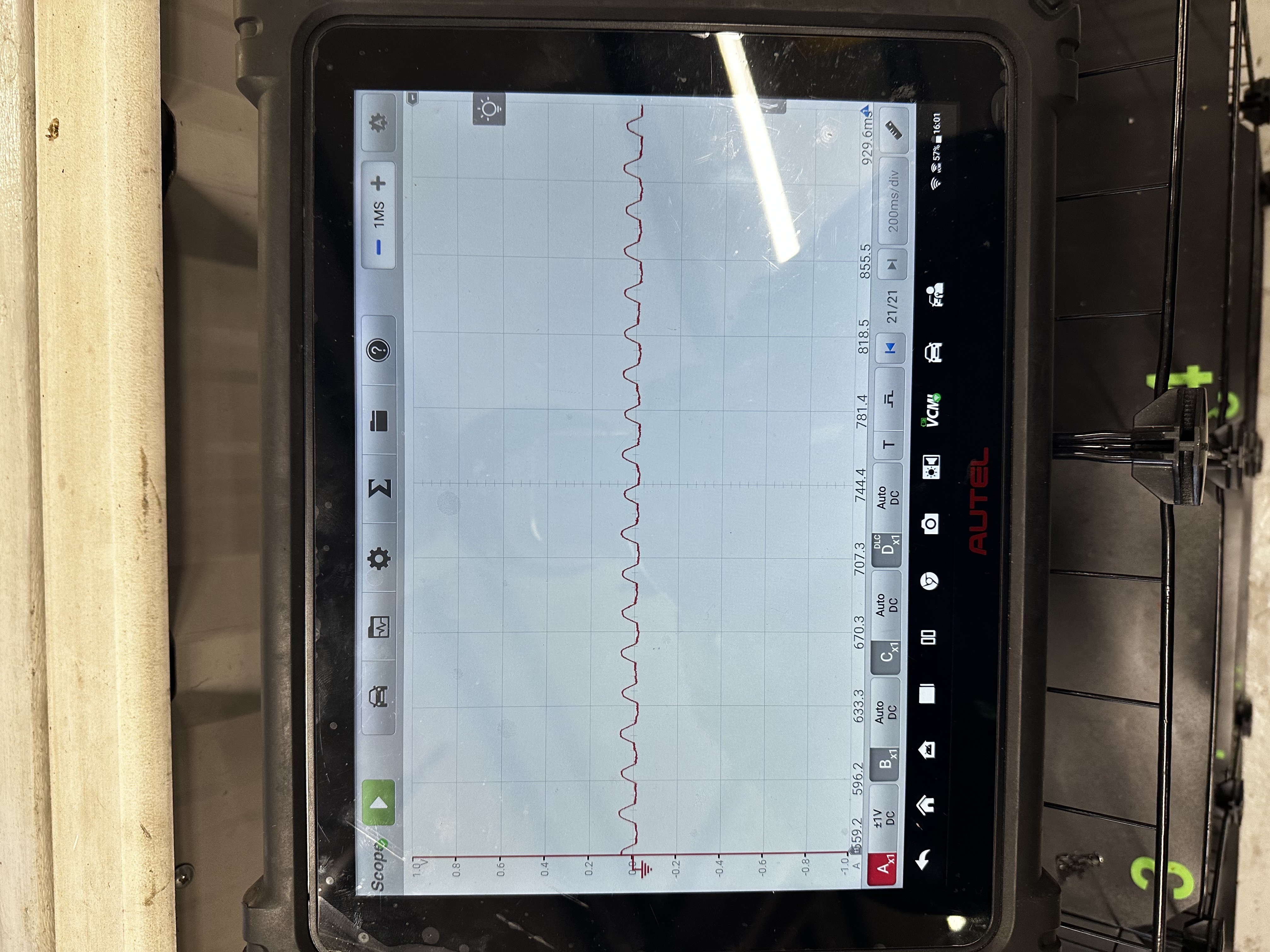
The Autel diagnostic tablet in oscilloscope mode — measuring a live electrical signal from a vehicle sensor during diagnostic work at our Rhyl workshop.
Oscilloscope analysis is one part of the diagnostic toolkit used at Shaw's for cases where it is the right tool for the job. It is particularly useful for:
- Intermittent faults that do not store consistent codes
- Sensor signal quality issues where the sensor produces a signal but the signal is not correct
- Electrical faults where the circuit itself needs examining rather than just its outputs
- Timing-related faults involving multiple sensors whose relationship to each other matters
- Situations where a fault code points to a system rather than a specific component and further investigation is needed before recommending a part
Not every fault requires oscilloscope analysis. Many faults are identified correctly through fault code reading combined with live data and a methodical approach. But for the faults where oscilloscope testing provides information that nothing else does, having the equipment and the training to use it properly is what makes the difference between an accurate diagnosis and an expensive guess.
Diagnostic fault assessment at Shaw's
A Shaw's Diagnostic Fault Assessment is not simply plugging in a code reader. It is an investigation, and the depth of that investigation depends on what the vehicle presents.
Advanced diagnostic work — including oscilloscope-based diagnosis — is carried out at our Rhyl branch.
The initial diagnostic assessment fee is £150. This covers the investigation — not unlimited diagnostic time, dismantling or repairs, which are quoted separately if required.
If we recommend further investigation or a repair, we explain what we found and why before any work proceeds.
Find out about diagnostic services at Shaw's →
We check it properly.
We explain it properly.
We do the job properly.
You decide what gets done.
Shaw's Service Station
Rhyl (advanced diagnostics) & Kinmel Bay
01745 353481