
When the Fault Isn’t Where the Code Points — How We Diagnose Wiring and Electrical Problems
Fault codes identify which circuit has reported a problem. They do not identify where in that circuit the fault lies. Here is how Shaw’s investigates wiring faults beyond the part the code names.
Vehicle fault codes are logged by control modules when a signal or parameter falls outside expected limits. The code references a circuit — and usually names the sensor, actuator or system the module associates with that circuit.
The naming is useful. It is not a parts list.
What a fault code tells you — and what it does not
A code that references a component does not tell you whether that component has failed, whether a connector has corroded, whether a wire has chafed through and is intermittently grounding, or whether the signal is being interrupted somewhere between the control module and the component. All of these conditions can produce the same code. Replacing the component because the code names it is sometimes correct. It is sometimes wrong — and when it is wrong, the code returns with a new component fitted and the same fault unresolved.
Finding the actual cause requires testing the circuit, not just reading the code.
How circuits are tested
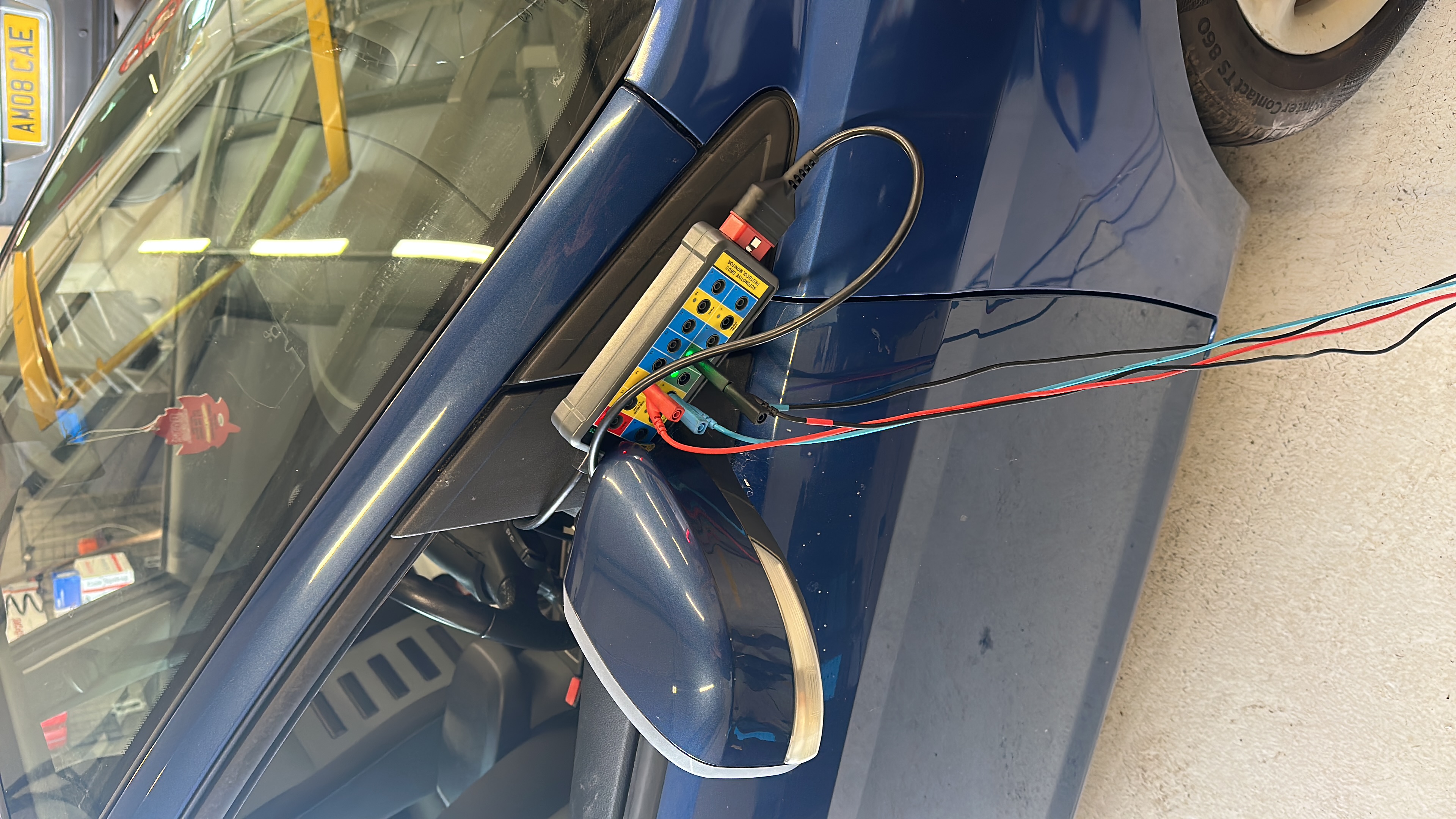
A breakout box fitted to a wiring connector on a vehicle — an electrical test junction that intercepts the circuit at a specific point. The colour-coded ports accept test leads from a multimeter or oscilloscope, allowing voltage, resistance and signal measurements without cutting or probing through wiring insulation.
A breakout box is an electrical test adapter that fits into a wiring connector in the middle of a circuit. Once fitted, the circuit is still complete — the component still functions — but test leads can now be connected to each individual wire in the connector.
This allows the technician to measure exactly what is happening at that specific point:
- Voltage — is the correct supply voltage reaching this point? Is the ground reference present?
- Resistance — is there continuity between here and the next connector? Is there unwanted resistance on a ground wire indicating a poor connection?
- Signal quality — is the signal from the control module arriving at the component correctly, or is it being distorted between the two?
The information gathered at each test point progressively narrows the fault location — from the broad area identified by the code, to the specific wire, connector pin or component that is actually causing the problem.
When the wiring is the fault
Wiring faults are often the hardest to locate because they are frequently intermittent. A chafed wire that makes contact in one position but not another, a connector that has corroded over winter, a terminal pushed back slightly — these produce inconsistent faults that store a code and then clear it, and cannot always be reproduced under workshop conditions.
This is where an oscilloscope adds value — not just for engine sensors, but for any circuit where signal quality or timing matters. A corroded connector does not just reduce voltage: it changes the shape of the waveform passing through it. An oscilloscope shows this directly and allows the fault location to be confirmed rather than guessed at.
Multi-channel analysis in practice
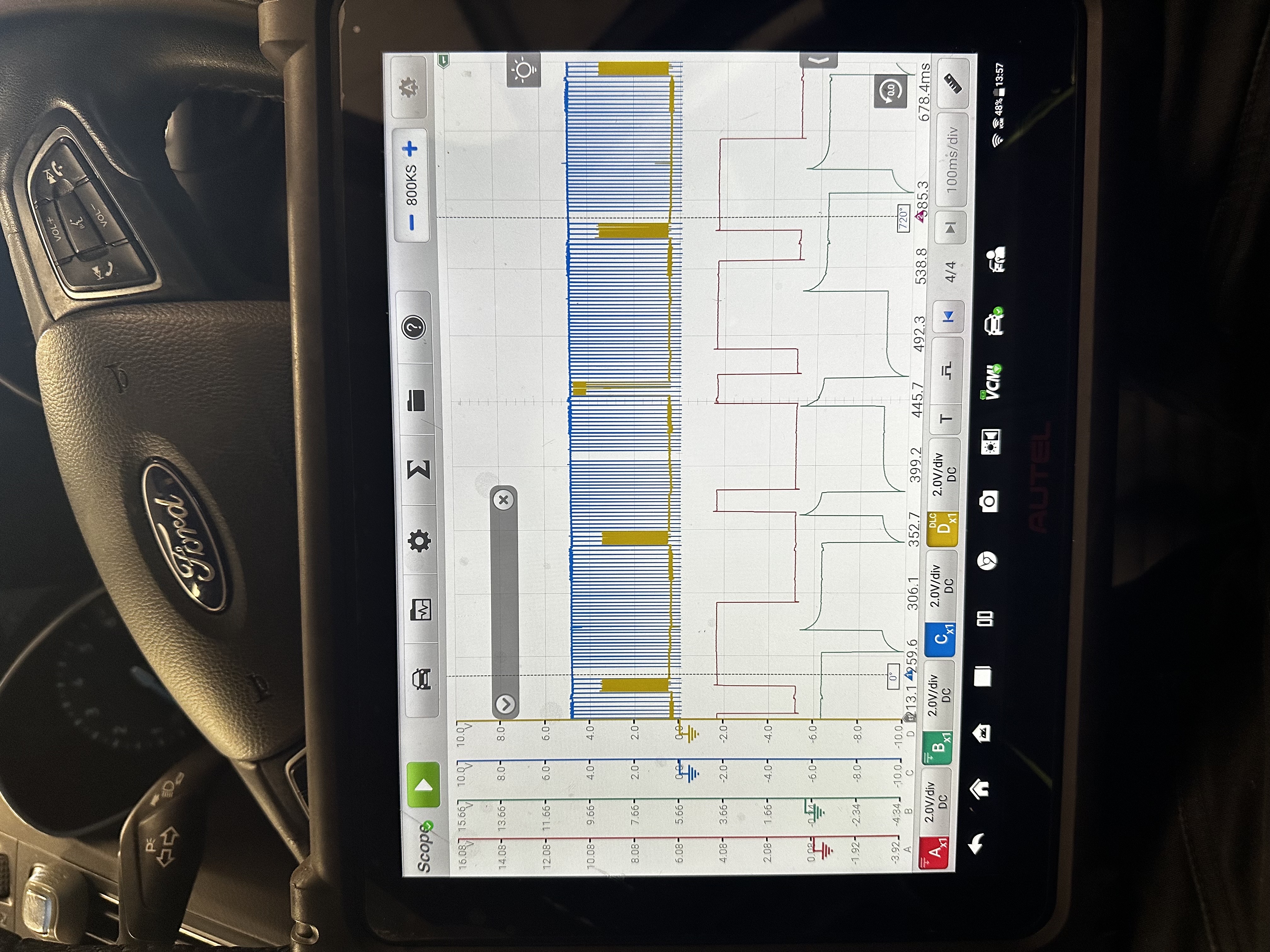
Multi-channel oscilloscope analysis inside a vehicle — comparing signals from multiple engine management sensors simultaneously. The 720° reference marker on the trace identifies one complete engine cycle, used to verify that sensor timing relationships are correct.
Comparing multiple signals simultaneously confirms whether signals are correctly synchronised, or whether a fault affects only one channel. A signal that appears correct in isolation may reveal a timing error only when compared against the reference it should be aligned with.
Electrical diagnostic work at Shaw’s
If we recommend replacing a part, it is because we have tested the circuit and confirmed the component is the cause — not because the code named it. Advanced electrical fault finding is carried out primarily at our Rhyl branch. The diagnostic assessment fee is £150. Any components, wiring repairs or further work are quoted separately and agreed before proceeding.
Find out about diagnostic services at Shaw’s →
We check it properly.
We explain it properly.
We do the job properly.
You decide what gets done.
Shaw’s Service Station
Rhyl (advanced diagnostics) & Kinmel Bay
01745 353481