
What We Found on a Routine Suspension Check — And Why It Needed to Come Off the Road
A cracked control arm is not a wear item. It is a structural failure in the suspension. Here is what it looked like, why it gets missed, and why catching it mattered.
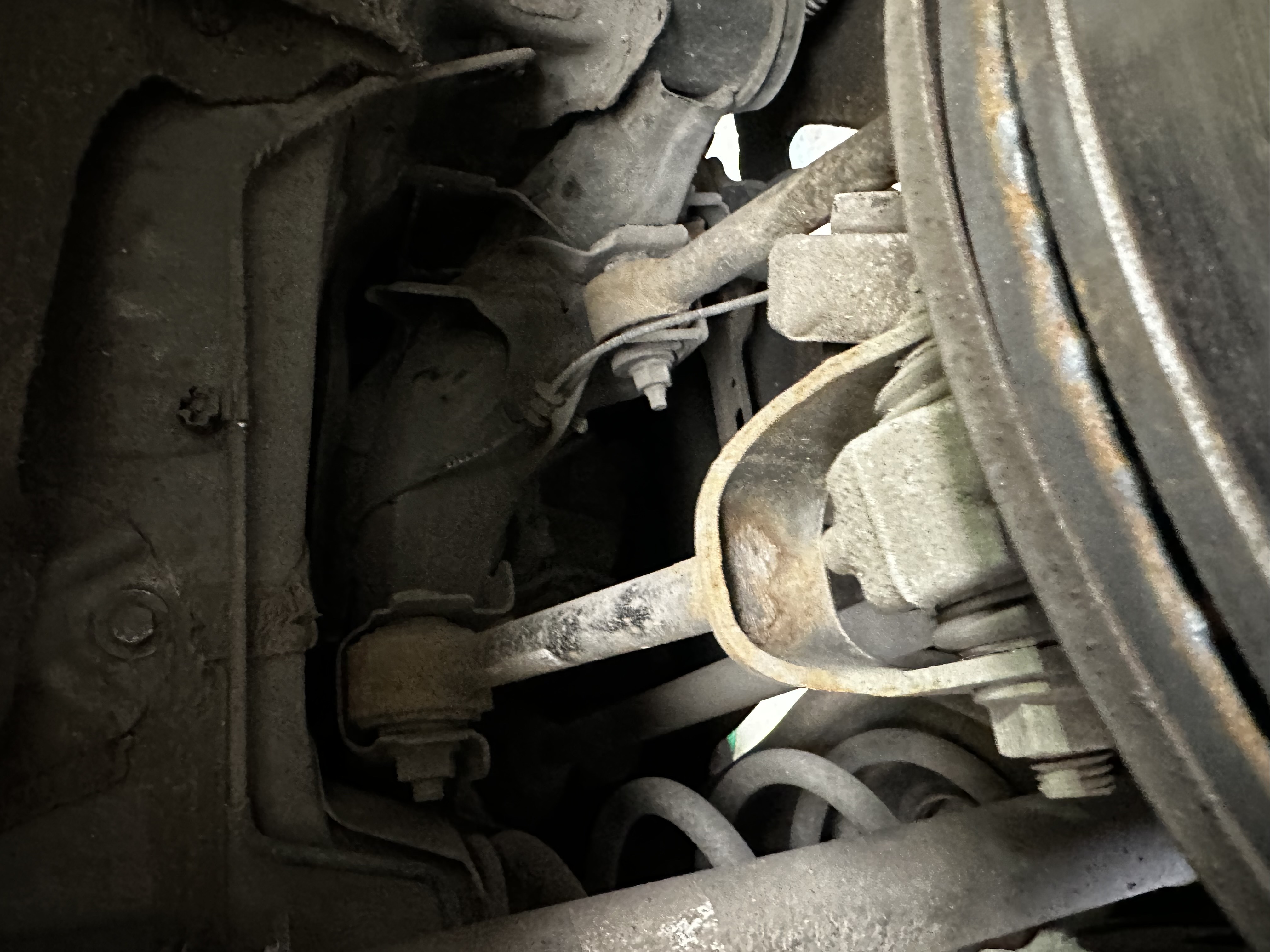
Suspension problems do not always announce themselves dramatically. Sometimes a vehicle comes in for a noise or handling concern, or for a check during a service. And sometimes what we find is not what we expected.
The photographs in this article are from a recent job at our workshop. The vehicle came in for a suspension inspection. What we found on one of the front control arms was not a wear issue. It was a structural failure.
What a control arm does
A control arm is one of the fundamental links in a vehicle's front suspension. It connects the wheel hub — and therefore the wheel and tyre — to the vehicle's subframe or chassis. Every movement the wheel makes relative to the body passes through the control arm.
During cornering, braking, accelerating and hitting bumps in the road, the control arm absorbs and manages those forces while allowing the wheel to travel through its designed arc of movement. Rubber bushings at each end isolate vibration and allow that movement without transmitting every road imperfection directly into the steering and body.
A worn bushing reduces ride quality and handling precision. A cracked control arm is something else entirely.
What we found
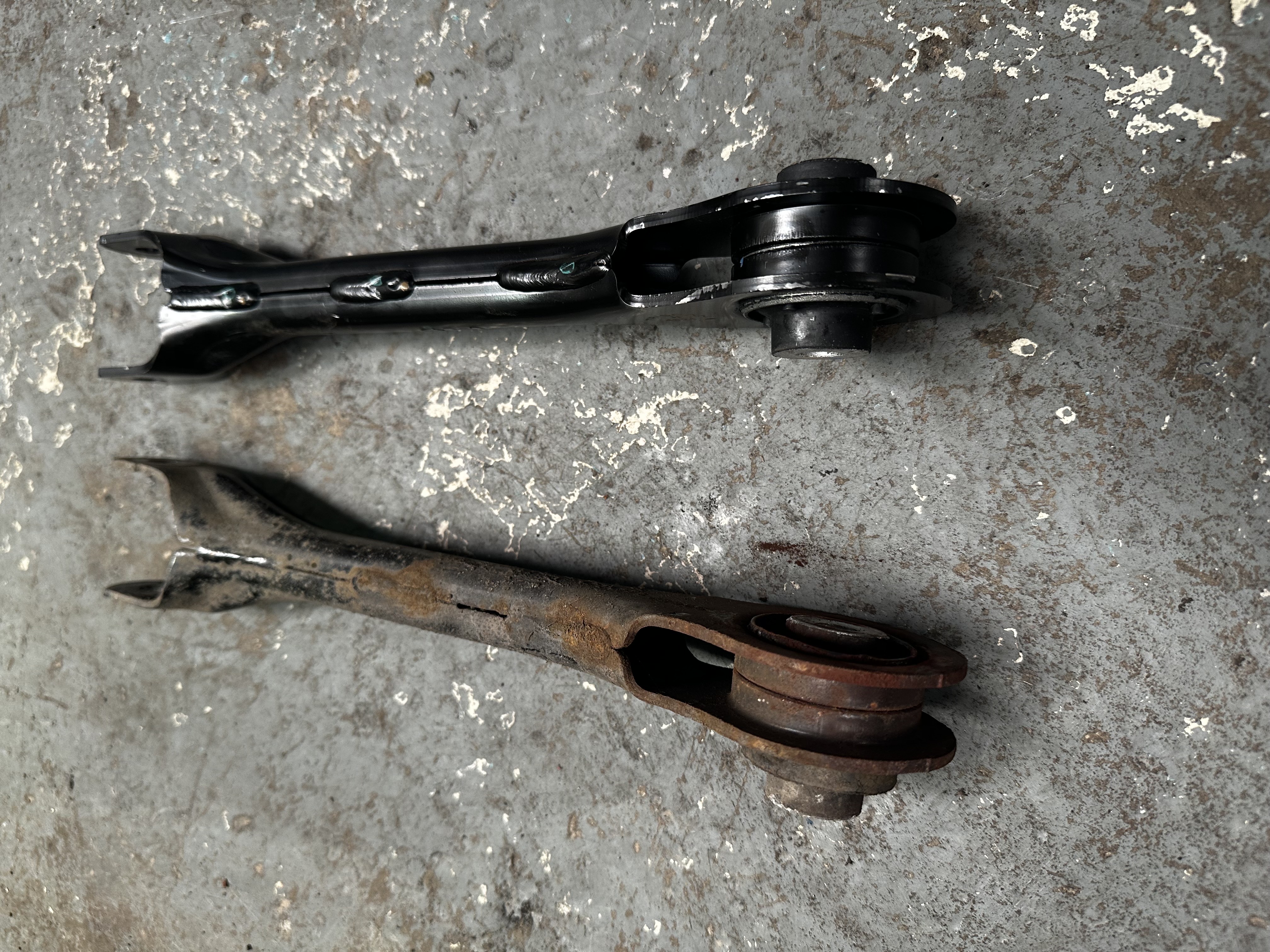
The old control arm alongside its replacement. The crack running through the body of the old arm is visible across its main structural section. This is not surface corrosion. The metal had failed.
The old control arm on the left has a visible crack running through its structural body — not a surface stress mark, not corrosion that could be cleaned off, but a fracture through the metal itself.
This is the type of finding that changes the nature of the job. A worn bushing gets flagged as something to monitor or replace at the appropriate time. A cracked structural component is something the vehicle should not be driven on until it is fixed.
The cause is typically a combination of age, corrosion and cumulative stress — an arm that has carried significant load for many years in a corroded state will develop fatigue cracks over time. From the outside of the vehicle, there is often nothing to see. The crack becomes visible only when the arm is removed and can be properly inspected.
The bushing condition told the same story
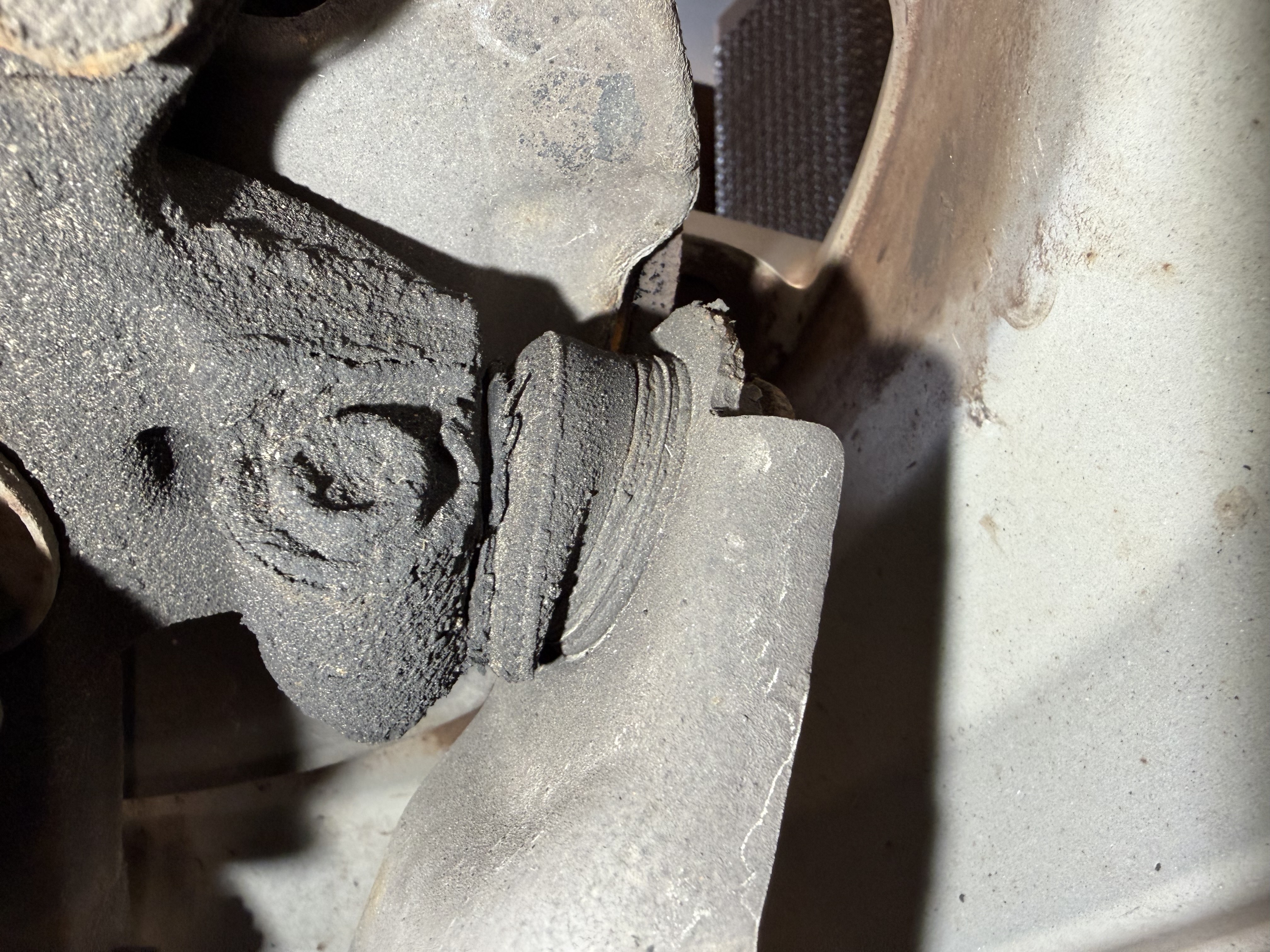
The control arm bushing as found on the vehicle — heavily corroded and contaminated, with the rubber deteriorated and no longer providing the vibration isolation it is designed for.
The bushing in the photograph above — still in position on the vehicle before removal — shows the same pattern: significant corrosion and contamination, the rubber deteriorated and no longer functioning correctly.
Worn bushings contribute to imprecise handling, vague steering feel, and sometimes a knocking or clunking noise over bumps. They are a normal wear item on older vehicles. But replacing just the bushing with the arm in the condition shown above would not have been the right answer — the arm itself needed to come off.
What happens if a cracked control arm fails completely
A control arm that has cracked through its main body and fails while the vehicle is moving can no longer locate the wheel correctly. The consequences depend on speed and circumstances, but at minimum they include an immediate and uncontrolled change in the vehicle's direction and handling.
This is why a cracked control arm is treated as something that needs addressing before the vehicle is driven — not something to monitor and book in when convenient.
Why the inspection matters
This finding came from an inspection. The crack was not necessarily causing an obvious symptom before the arm was removed. It became visible only because someone looked at the component properly once it was out of the vehicle.
An MOT checks suspension condition, but it does not automatically involve removing suspension arms to inspect their structural faces. A visual inspection from below with the wheels still on the vehicle can miss a crack that is not on an exposed surface. Getting the component out and looking at it is the only way to be certain.
Suspension checks carried out during servicing or during work that involves removing wheels give Shaw's the opportunity to inspect these components properly — not just check what is visible from the outside.
Suspension work at Shaw's
Suspension inspection and component replacement is carried out at both our Kinmel Bay and Rhyl branches. If we find something during an inspection, we show you what we found and explain the recommendation before any work is authorised.
Suspension concern? Get in touch with Shaw's →
We check it properly.
We explain it properly.
We do the job properly.
You decide what gets done.
Shaw's Service Station
Kinmel Bay & Rhyl
01745 353481