
What the Numbers on an AC Manifold Gauge Mean — How Shaw’s Reads the System Before Deciding What It Needs
The high side and low side pressure readings on an AC manifold gauge are the most direct measurement of what the refrigerant circuit is doing. Here is what Shaw’s looks for.
A recharge alone does not tell you what is happening inside the air conditioning system. The manifold gauge does. By connecting to both the high side (discharge) and low side (suction) service ports, it gives a live pressure and temperature reading from each part of the circuit that makes it possible to tell whether the system has a refrigerant quantity problem, a compressor problem, a restriction, or a moisture issue — before any parts are changed.
The two sides of the AC circuit
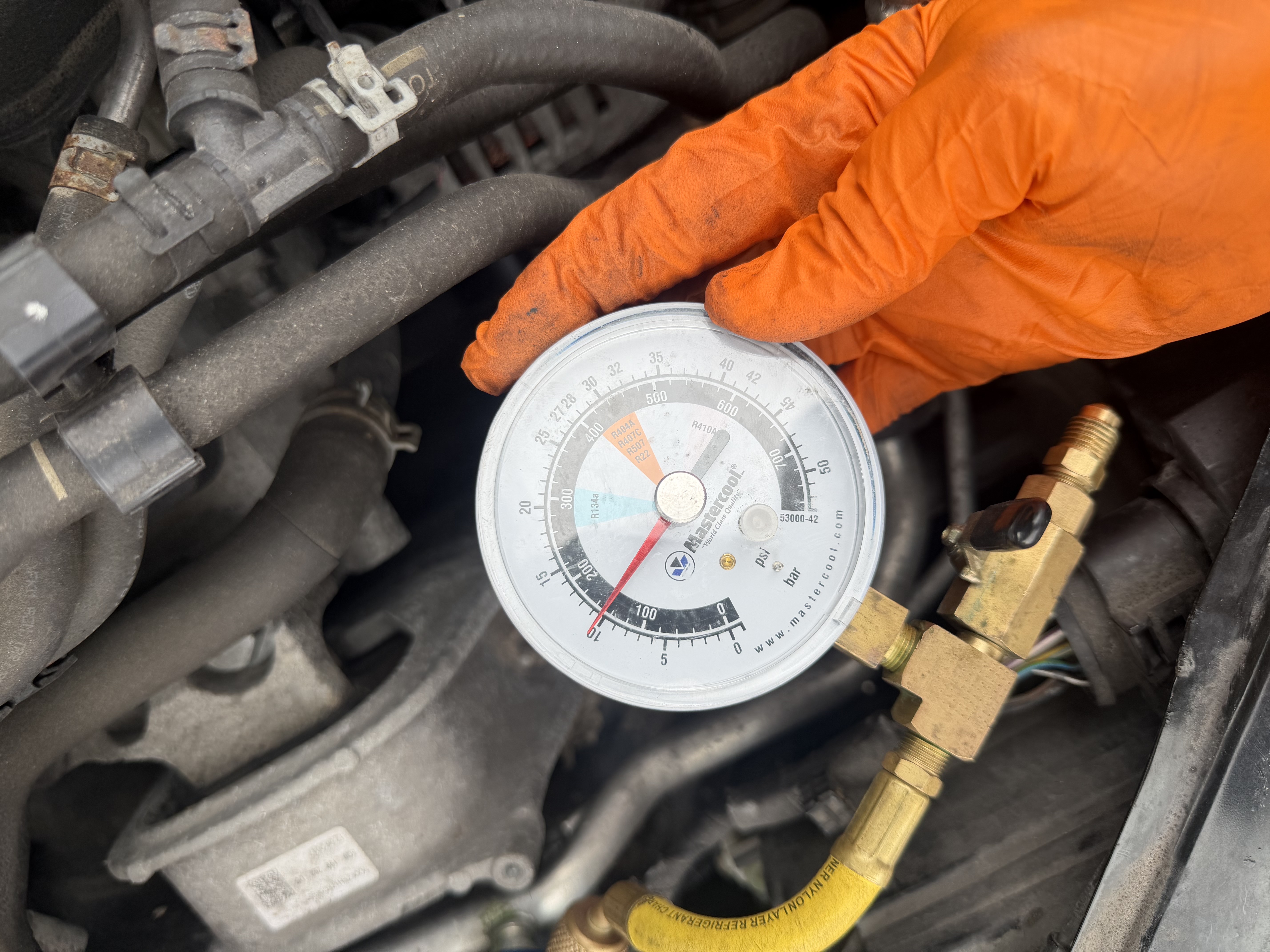
An AC service gauge connected at the low side service port. The analogue dial shows pressure in psi and bar with colour-coded zones for each refrigerant type (R134a in blue, R404A, R507 and others visible around the face). The yellow hose connects to the refrigerant charging station. This is the low side reading — the suction side of the compressor, which should read within a defined range when the system is operating correctly.
The refrigerant circuit has two pressure zones:
- The high side (discharge) — refrigerant compressed by the compressor, travelling through the condenser (the front-mounted heat exchanger) and into the expansion device. On a working R134a system at idle in moderate ambient temperatures, this typically reads 200–300 psi (14–20 bar)
- The low side (suction) — refrigerant returning from the evaporator (inside the cabin) to the compressor inlet. This should typically read 25–45 psi (1.7–3.1 bar) at idle with the AC operating and the cabin cooling
What the readings indicate
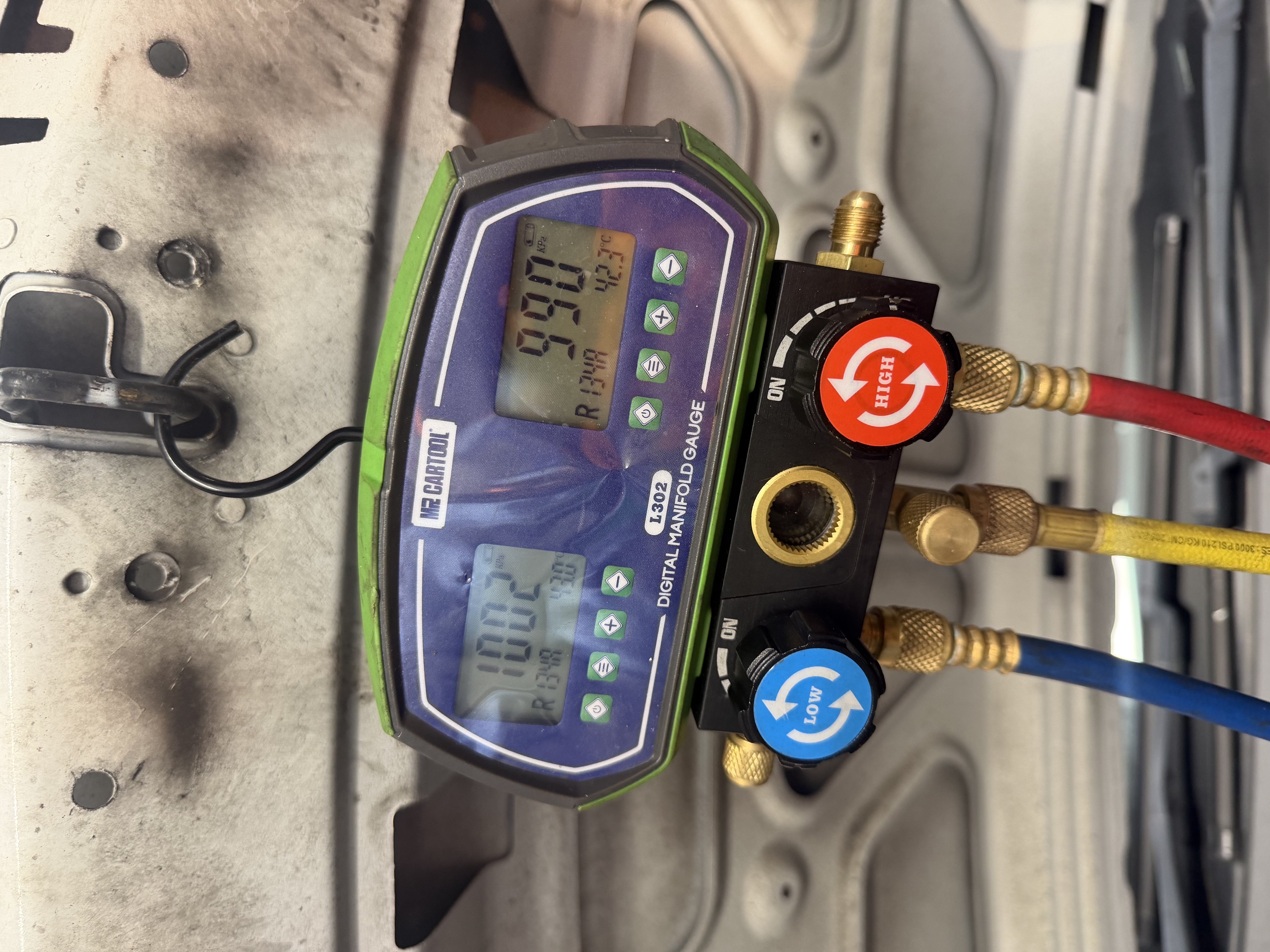
A digital manifold gauge showing both the high and low side pressure and temperature for an R134a system. The digital display allows precise readings alongside the calculated refrigerant temperature at each side, which is used to assess superheat and subcooling — measures of how efficiently the refrigerant is completing its cycle.
Different fault conditions produce characteristic pressure signatures:
- Low on both sides — indicates low refrigerant charge. The system needs a leak check before recharging
- High on both sides — indicates overcharge (too much refrigerant), restricted airflow through the condenser, or a condenser fan failure
- Normal high side, high low side — the compressor is not compressing adequately; compressor wear or valve failure
- Normal high side, very low or fluctuating low side — restriction in the expansion valve or orifice tube; moisture in the system causing ice formation at the expansion point
- High side fluctuating, low side dropping into vacuum — classic expansion valve blockage pattern, often caused by moisture or debris
Why this matters before a recharge
Shaw’s does not recharge an AC system without reading the manifold pressures first. Recharging a system with a compressor that is not compressing, or a restriction that has not been cleared, wastes refrigerant and does not fix the underlying fault. The gauge reading takes minutes and tells us whether a recharge alone will resolve the complaint or whether further investigation is needed.
AC service pricing at Shaw’s: R134a recharge £95, R1234yf recharge £150. Leak check £50.
Book your AC service at Shaw’s →
We check it properly. We explain it properly. We do the job properly. You decide what gets done.
Shaw’s Service Station | Kinmel Bay & Rhyl | 01745 353481