
What an Electric or Hybrid Vehicle Still Needs Servicing — The Maintenance Schedule People Miss
An EV has no engine oil, no cambelt and no exhaust. But it still has brakes, tyres, coolant, suspension, a 12V battery and a cabin filter. Here is what the service schedule actually looks like.
One of the common misconceptions about electric and hybrid vehicles is that they require almost no maintenance. This is partially true and significantly overstated. An EV has fewer maintenance items than a comparable petrol or diesel vehicle, but several of the remaining items are just as important — and some are more critical because they are less commonly inspected.
What an EV or hybrid still needs serviced
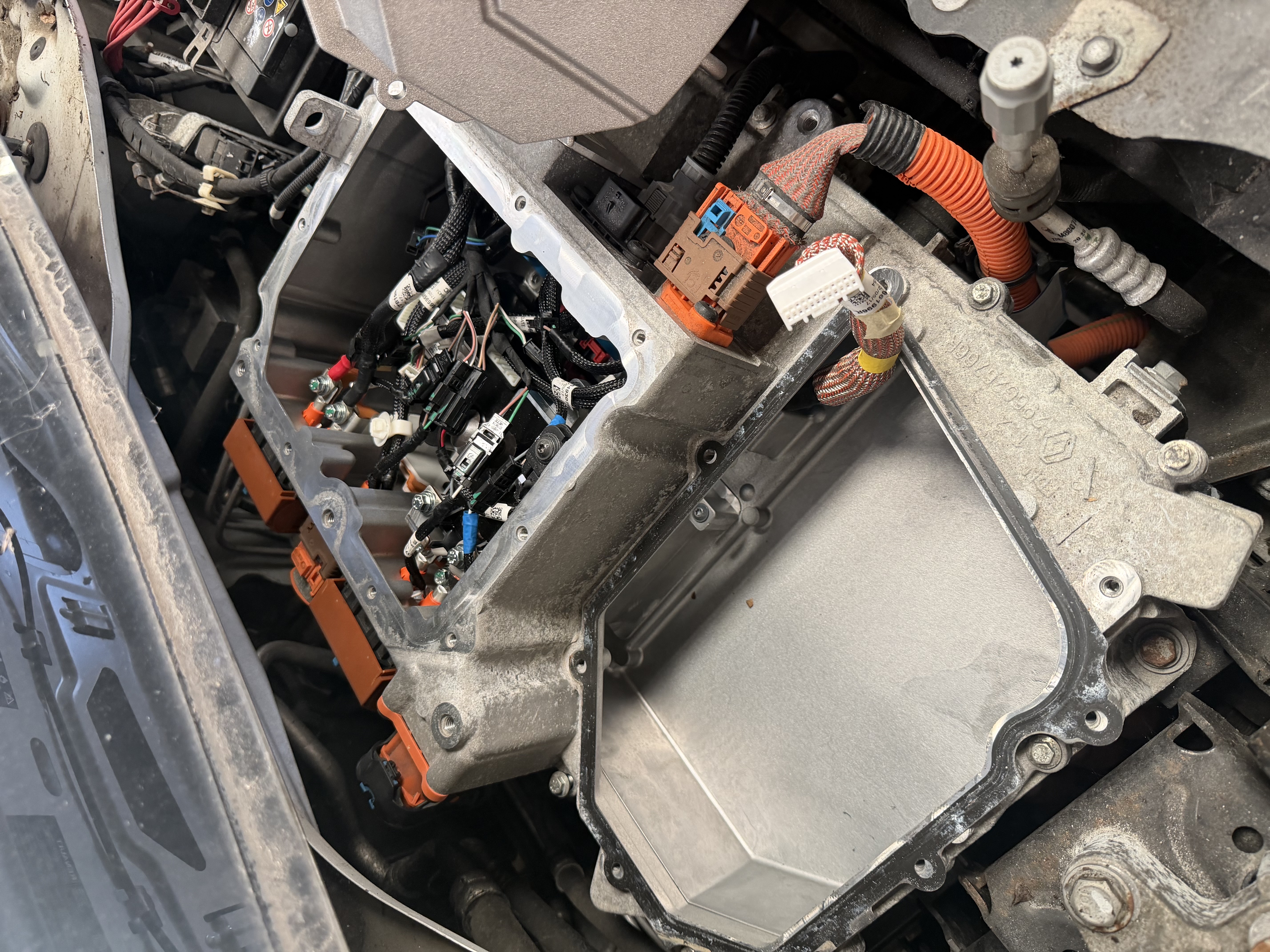
The high-voltage power electronics compartment of an electric vehicle at our Rhyl workshop. While the HV system itself has few consumable components, the supporting systems — thermal management, cooling circuits, and the 12V network — all require periodic inspection and service to function as designed.
- Brake fluid — this is particularly important on EVs and hybrids. Because regenerative braking does most of the work of slowing the vehicle, the friction brakes are used less frequently than on a conventional car. Less use means less heat cycling, which means less of the moisture that heat drives off. EVs can accumulate moisture in the brake fluid faster than the equivalent conventional vehicle, even at low mileage. Two-year intervals apply equally to EVs
- Tyres — EVs are heavier than equivalent petrol cars due to the battery pack, and the instant torque delivery of an electric motor causes more wear at the front and rear contact patches than a petrol engine of equivalent power. Tyre inspection and rotation is at least as important on an EV as on any other vehicle
- Cabin air filter — unchanged from a conventional vehicle. A blocked cabin filter reduces HVAC airflow, which on an EV also reduces battery thermal management efficiency in vehicles where the HVAC system is used for battery conditioning
- Coolant — EVs have a separate coolant circuit for the HV battery and inverter. This is not the same as engine coolant on a petrol vehicle but serves the same function. It degrades over time and requires periodic replacement — typically every 5 years or according to the manufacturer’s schedule
- 12V battery — every EV and hybrid has a conventional 12V battery that powers the low-voltage electrical systems. This battery is subject to the same degradation and failure modes as any 12V battery. It does not charge from the main HV battery during normal driving in the same way that a conventional alternator keeps a 12V battery charged, and 12V battery failure in an EV can prevent the HV system from initialising. EV 12V batteries should be tested periodically
- Suspension, steering and brakes — unchanged from a conventional vehicle. These components experience the same wear patterns and require the same inspection intervals. On EVs with lower unsprung weight (hub motor vehicles) or higher kerb weight (heavy battery pack), suspension wear rates may differ from the petrol equivalent
What an EV does not need
No engine oil. No oil filter. No spark plugs. No cambelt. No exhaust system. No lambda sensors. No particulate filter. No conventional gearbox service (most single-speed EVs have sealed drive units with no service interval). These are genuine maintenance savings, and over the long term they are significant.
EV and hybrid servicing at Shaw’s
Shaw’s carries out EV and hybrid servicing at both Kinmel Bay and Rhyl branches. High-voltage diagnostic and repair work is HEVRA-certified and scoped to our Rhyl branch. Contact us to discuss the service schedule for your specific vehicle.
Book your EV or hybrid service at Shaw’s →
We check it properly. We explain it properly. We do the job properly. You decide what gets done.
Shaw’s Service Station | Kinmel Bay & Rhyl | 01745 353481