
What a Full Vehicle Health Check Shows — And Why It’s Different From an MOT or Service
An MOT tests whether the car meets the legal minimum. A service replaces defined items. A health check tells you the current condition of every electronic system on the vehicle. Here is what Shaw’s finds.
The three most common assessments a car goes through — the MOT, the service and the health check — measure different things. Understanding the difference helps you make better decisions about what your vehicle actually needs.
What each one covers
An MOT tests a defined list of safety and environmental items against a pass/fail threshold. It does not check the engine’s electronic health, the condition of brake fluid, whether the battery is degraded, or whether any non-safety fault codes are stored. It is a legal roadworthiness threshold, not a condition report.
A service replaces scheduled consumable items — oil, filter, spark plugs at interval, and so on — and carries out a visual inspection of defined items. What is replaced depends on the service type (minor, interim or full) and the manufacturer’s schedule. A service does not read fault codes from all modules or assess electronic system health.
A vehicle health check is a full electronic scan of every control module on the vehicle, combined with a visual inspection of key mechanical systems. It is the most comprehensive single snapshot of the vehicle’s condition.
What a full health check at Shaw’s covers
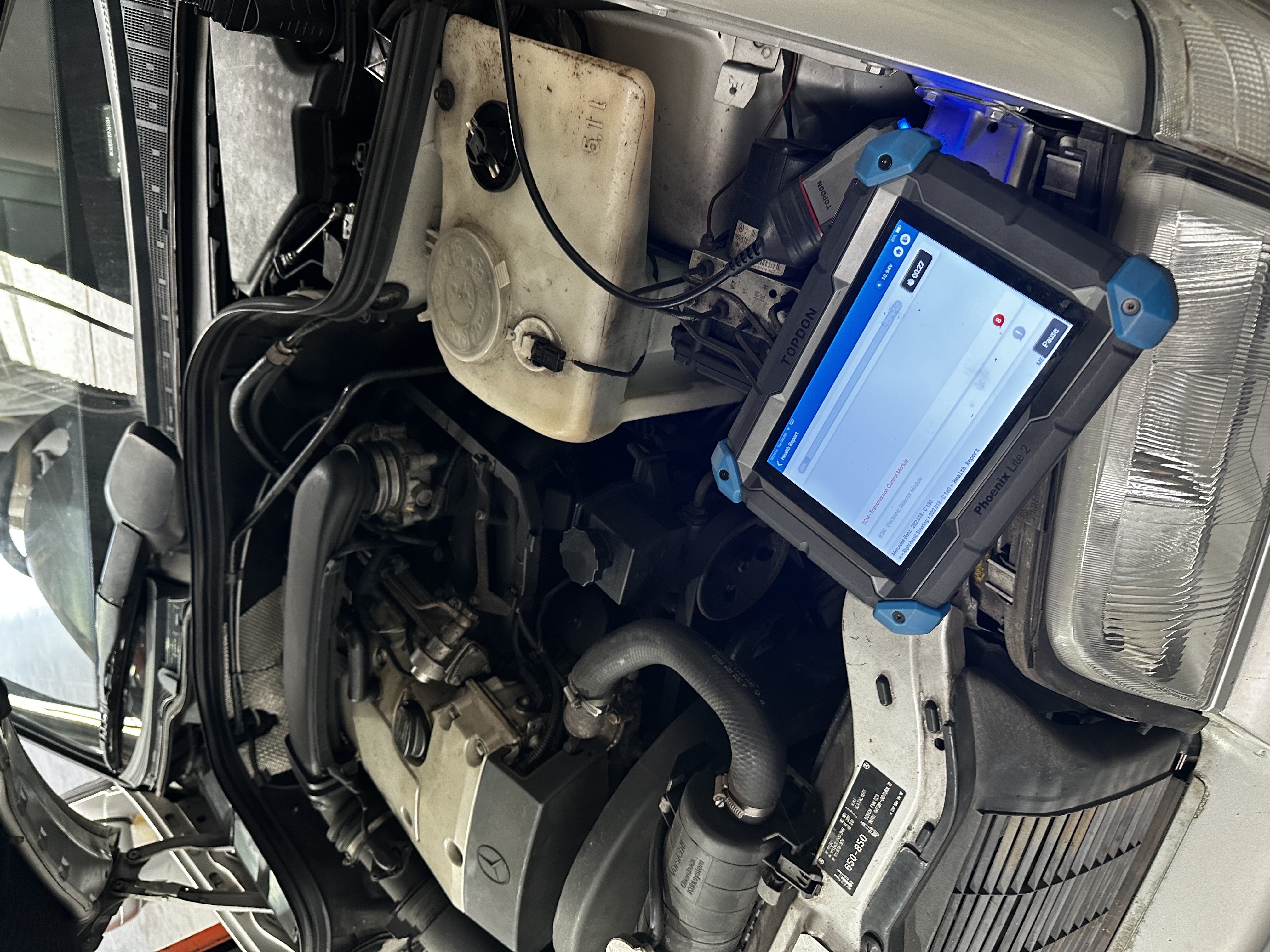
The TOPDON Phoenix diagnostic tool running a full system health scan. The software works through each control module in turn — engine, transmission, ABS, airbag, body control, climate control, and more — querying for stored and pending fault codes and live data from each. The health report at the end gives a module-by-module status that no visual inspection can replicate.
At Shaw’s, a full vehicle health check includes:
- A full scan of all accessible control modules for stored, pending and permanent fault codes
- Live data review of key parameters — fuel trims, oxygen sensor behaviour, coolant and oil temperature, battery voltage at start and under load
- Visual inspection of tyres (tread and condition), brake pad thickness (visual estimate), lights, fluid levels and visible leaks
- A report of findings with a plain-English explanation of what each fault or observation means
When a health check is most useful
A health check is particularly valuable when buying a used vehicle — it surfaces fault codes that a seller may have cleared, or that have not yet triggered a warning light. It is also useful when a dashboard warning light has been present and cleared without investigation, or when a vehicle has been sitting unused for an extended period.
A health check before an MOT means known faults are identified and addressed before the test rather than discovered as a failure. A health check after a minor accident identifies whether any control modules have stored impact-related fault codes that may not be immediately visible.
Book a vehicle health check at Shaw’s →
We check it properly. We explain it properly. We do the job properly. You decide what gets done.
Shaw’s Service Station | Kinmel Bay & Rhyl | 01745 353481