
Oil Leaks, Coolant Leaks, Refrigerant Leaks — How Shaw’s Finds the Source Without Guessing
A wet patch under your car, a sweet smell from the vents, an engine that keeps needing water — these are symptoms. Finding the source requires the right tools and a methodical approach.
A wet patch under your car tells you something is leaking. It does not tell you what fluid it is, where it is coming from, or whether the leak is at the top of the engine slowly working its way down before it drips onto the ground. Finding the source accurately is the first step — without it, any repair is a guess.
Why leak location matters before repair
Oil, coolant and power steering fluid can leave similar wet patches in similar locations. Coolant can evaporate from a hot engine and leave no residue at all. Refrigerant leaks in the AC system are invisible and odourless without the right equipment. A repair that addresses the wrong component — or the wrong end of a long-running leak path — will not fix the problem.
At Shaw’s, we use a combination of visual inspection, UV dye and pressure testing to locate leaks accurately before any repair is recommended.
UV dye leak detection
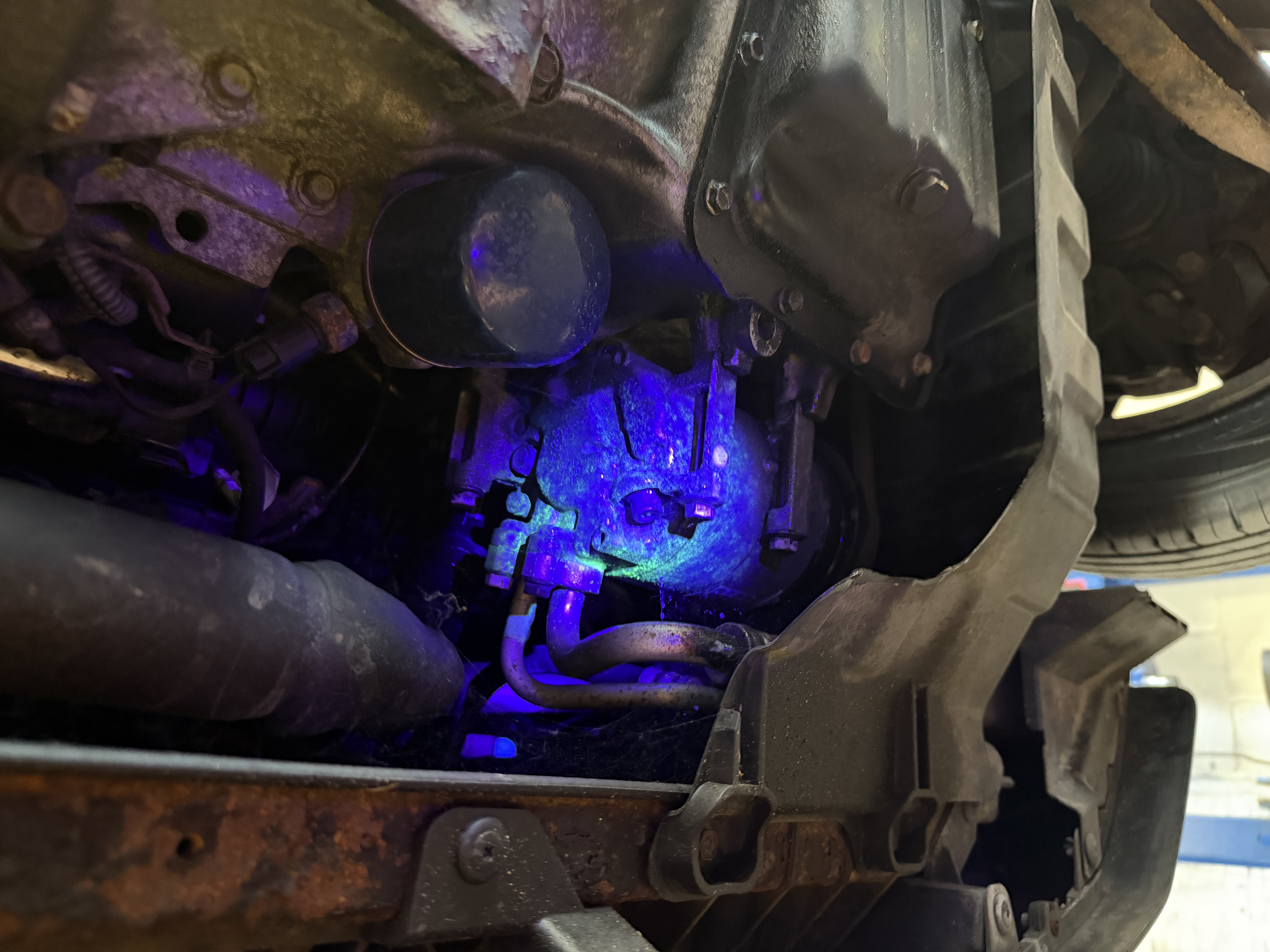
UV dye is a fluorescent tracer that, once introduced into a fluid system, follows the exact path of any leak. Under ultraviolet light, the dye glows brightly against surrounding metal and rubber, making it possible to identify the exact point of origin rather than the point where the fluid has collected.
This is particularly useful for:
- Oil leaks — where oil may run along pipes, brackets and wiring before dripping, creating a trail that leads away from the actual source
- Coolant leaks — where coolant can evaporate from a hot engine before reaching the ground, or drip from multiple points after a single source has been running for some time
- Air conditioning refrigerant leaks — where the leak is gaseous and invisible; UV dye is added to the AC system and the circuit inspected under UV light to find even very small leak points
- Power steering fluid leaks — where the rack, pump or pipe connections may each look similarly damp but only one is the source
Pressure testing for coolant system leaks
A coolant system pressure test pressurises the cooling circuit to its normal operating pressure while the engine is cold. If the system cannot hold pressure, the drop confirms whether the leak is external (visible) or internal — such as a failing head gasket, which allows coolant to pass into the combustion chamber without leaving any trace outside the engine.
An engine that consumes coolant without obvious external leaks, produces white smoke from the exhaust, or shows combustion residue in the coolant reservoir warrants a pressure test to assess the head gasket before the coolant level continues to drop.
What we do with the information
Once a leak is located, we explain what has failed, why, and what the options are for repair. Some leaks — a deteriorated rocker cover gasket, a coolant hose with a hairline crack, a loose union on a refrigerant pipe — are straightforward and inexpensive to fix. Others indicate more significant component failure. Either way, you know what you are dealing with before any repair work begins.
If a vehicle is losing fluid and the source has not been definitively identified, bring it to us and we will find it.
Book a leak diagnosis at Shaw’s →
We check it properly.
We explain it properly.
We do the job properly.
You decide what gets done.
Shaw’s Service Station
Kinmel Bay & Rhyl
01745 353481