
Inside the High-Voltage Components of an Electric Vehicle — What Shaw’s Inspects at Our Rhyl Workshop
Orange cables mean high voltage. Here is what Shaw’s trained technicians look for when working on EV and hybrid power electronics, and why the work cannot be done without specialist equipment.
When a petrol engine has a fault, the consequences of an uncontrolled discharge are limited. When a high-voltage EV or hybrid system is involved, the voltage levels involved — typically 200–900V depending on the vehicle — are immediately life-threatening if correct isolation procedures are not followed. This is why EV and hybrid high-voltage diagnostic work at Shaw’s is scoped and restricted to our Rhyl branch, where we have trained and HEVRA-certified technicians.
What high-voltage components are involved
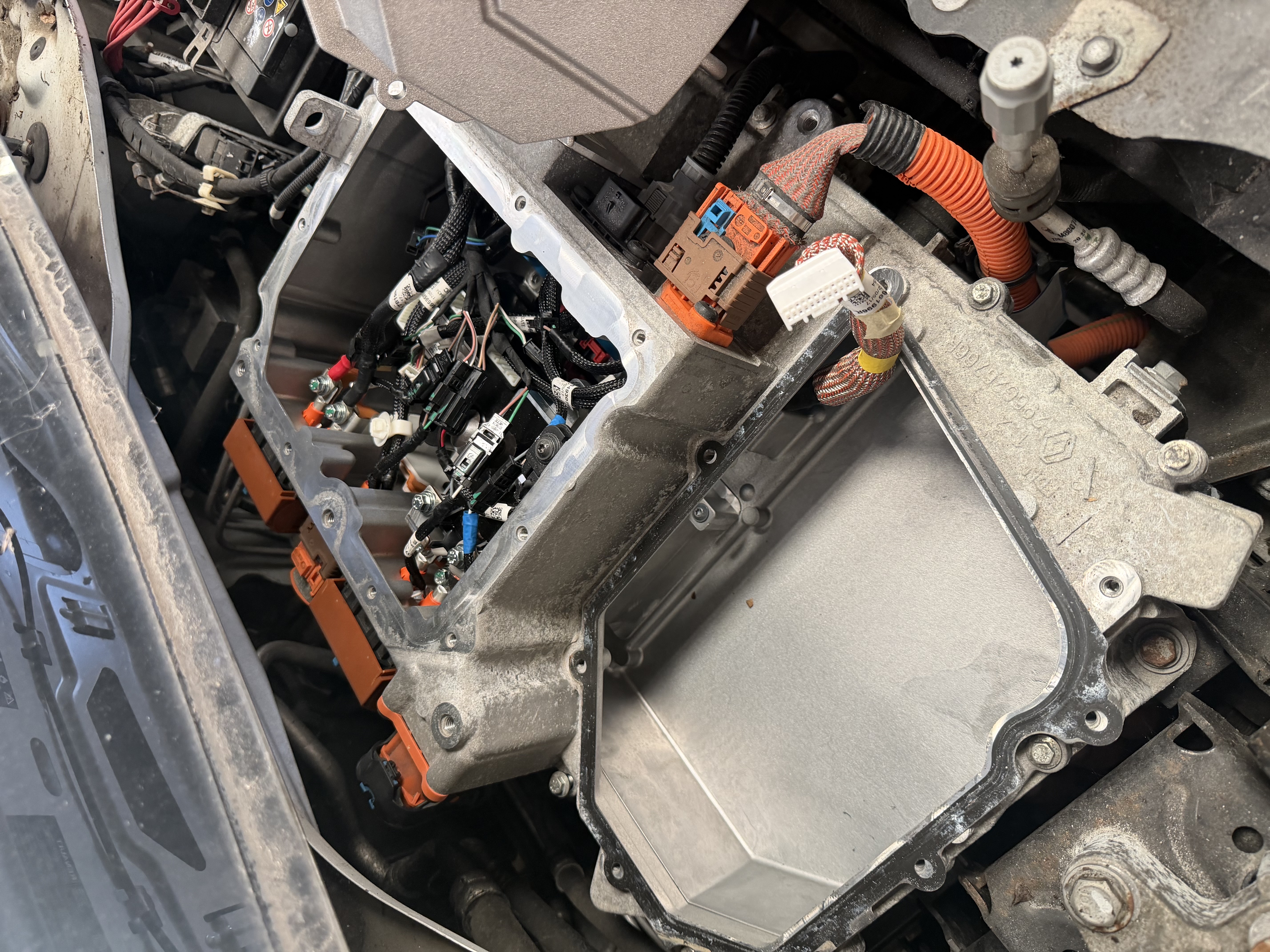
The opened inverter/power electronics compartment of an electric vehicle at our Rhyl workshop. The orange cables are the high-voltage DC and AC conductors — orange is the industry-standard colour code indicating circuits operating above 60V DC or 25V AC. The internal connectors and wiring terminals are organised inside a metal enclosure that must be isolated from the vehicle’s 12V system before any work begins.
The core high-voltage components in a typical EV or hybrid are:
- The high-voltage battery pack — the main energy storage, typically 200–900V depending on the vehicle
- The inverter — converts DC from the battery to three-phase AC to drive the motor(s). The inverter is also the most common source of HV fault codes and efficiency complaints
- The DC-DC converter — steps the HV battery voltage down to 12–14V to power the conventional 12V systems (lights, ECUs, accessories)
- The on-board charger (OBC) — handles the AC charging input from the mains and converts it to DC for the HV battery
- The pre-charge circuit — limits inrush current when the HV system powers up, protecting the inverter capacitors
What an HV diagnostic assessment covers
Shaw’s diagnostic assessment for EV and hybrid HV systems covers isolation resistance measurement (checking the HV system is not leaking voltage to chassis ground), insulation resistance of HV cables, and voltage readings across the HV contactors before and after system activation. Fault codes stored in the BMS, inverter, OBC and motor control modules are read and cross-referenced with live data to understand what caused them.
Where a fault is identified in an HV component that requires removal and replacement — a failed inverter, a degraded battery module, a faulty OBC — we will advise on the repair options and expected costs. Major HV pack replacement on vehicles where the battery cost exceeds the vehicle’s value is discussed honestly at this stage.
What we do not do
Shaw’s does not carry out HV battery cell balancing, pack reconstruction, or inverter remanufacturing. Where the repair falls outside our current scope, we refer clearly to a specialist capable of doing the work safely. We will not perform HV work on a vehicle for which we cannot obtain the specific isolation and high-voltage access procedures from the manufacturer or HEVRA database.
Diagnostic assessment: £150. EV and hybrid diagnostic work is carried out at our Rhyl branch only.
Contact Shaw’s about EV or hybrid diagnostics →
We check it properly. We explain it properly. We do the job properly. You decide what gets done.
Shaw’s Service Station | Rhyl (EV/HV diagnostics) | 01745 353481