
Ignition Coil and Spark Plug Circuit Testing — What the Primary Waveform Actually Shows
A coil that tests as healthy on a basic scanner can still fail under load. Here is how Shaw’s reads the primary waveform to find ignition faults before they cause misfires and catalytic converter damage.
The ignition coil converts the car’s 12V supply into the high voltage (15,000–45,000V) needed to fire a spark plug across the electrode gap. On modern coil-on-plug systems, each cylinder has its own coil mounted directly onto the spark plug. When a coil fails, the cylinder it serves misfires — and if the misfire continues, unburnt fuel enters the exhaust and can destroy the catalytic converter within a few hundred miles.
Why a fault code alone is not enough
A P0351–P0358 fault code confirms that the ECU detected an ignition control circuit fault on a specific cylinder. But the circuit between the ECU and the coil includes the coil primary winding, the drive transistor inside the coil, and the wiring between them. Replacing the coil does not fix a wiring fault, and replacing the wiring does not fix a failing coil that still reads correctly on resistance tests. The primary waveform is the only measurement that captures the coil’s actual firing behaviour under operating conditions.
Reading the primary waveform
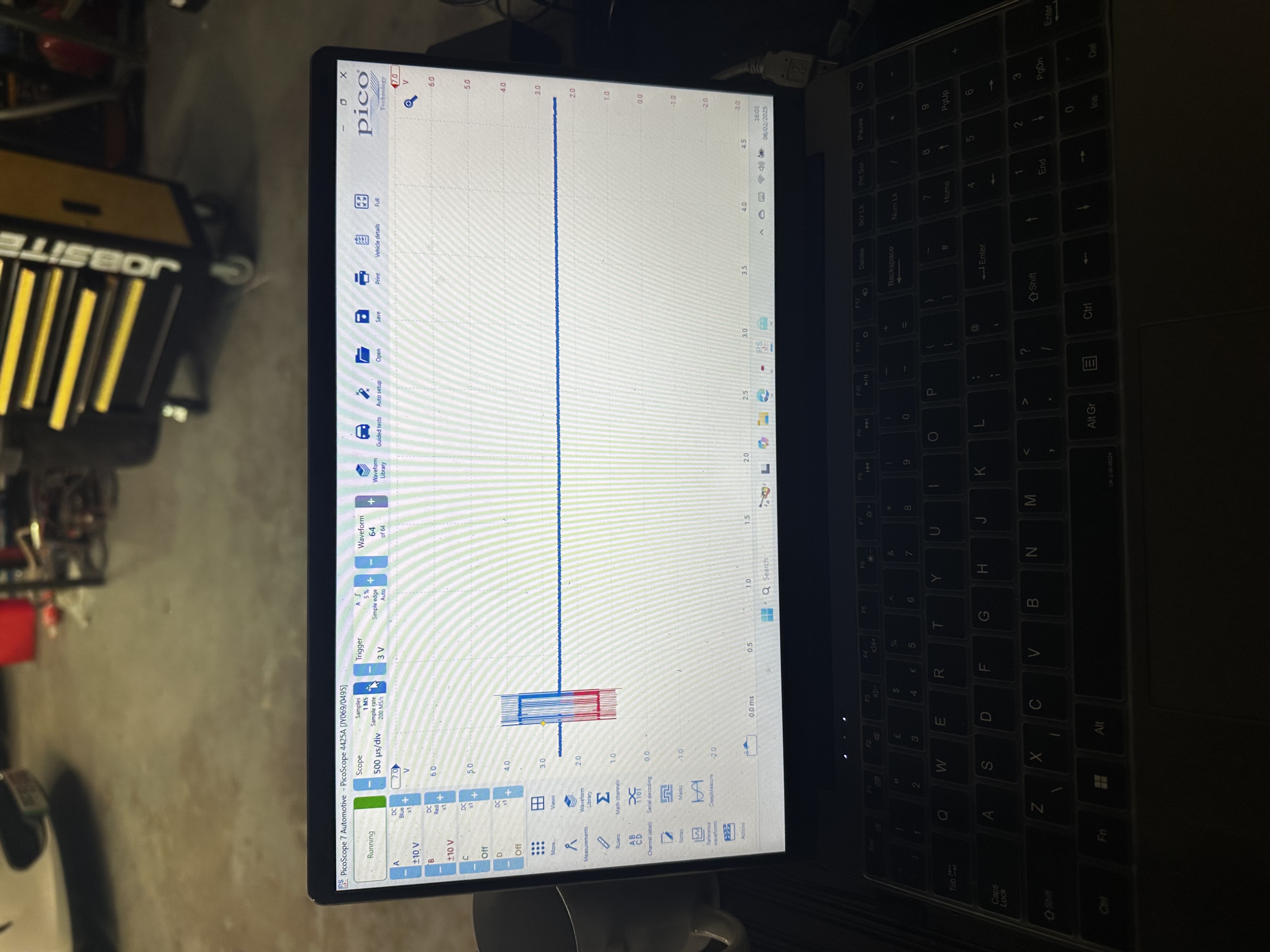
PicoScope 7 Automotive at 500 µs/div — a very short time base that captures the brief primary signal events in the ignition cycle. At this scale, the shape of each firing event is visible: the initial current ramp (dwell), the coil collapse and voltage spike at the point of firing, and the oscillations that follow the spark event. Comparing this shape across multiple cylinders immediately identifies a coil that is firing differently from the others.
The primary waveform for a healthy coil has a predictable shape:
- Dwell period — the coil is energised and current builds through the primary winding. This is visible as a current ramp on the waveform
- Firing event — the ECU switches off the primary current, the magnetic field collapses, and the induced voltage fires the spark plug. This appears as a sharp spike on the primary side
- Oscillation — the coil rings after the firing event. The number and regularity of oscillations indicates the health of the secondary winding (spark plug circuit)
A coil with a failing primary winding shows an incorrect dwell shape. A coil with a failing secondary (or a worn spark plug with a widened gap) shows fewer oscillations after the firing event. A coil that is intermittently cutting out shows missing firing events in the capture — visible when the trace is set to retain multiple captures.
Protecting the catalytic converter
A persistent misfire on any cylinder sends unburnt fuel into the exhaust. The catalytic converter attempts to oxidise this excess fuel, which raises its internal temperature significantly above its design range. A catalytic converter that has been subjected to prolonged misfire will fail — sometimes catastrophically, with the internal substrate melting and partially blocking the exhaust. A replacement catalytic converter typically costs £300–£1,200 depending on the vehicle. Diagnosing and fixing a misfire early is significantly cheaper.
Ignition system diagnostic work is carried out at our Rhyl branch. Diagnostic assessment: £150.
Contact Shaw’s about ignition diagnosis →
We check it properly. We explain it properly. We do the job properly. You decide what gets done.
Shaw’s Service Station | Rhyl (diagnostics) & Kinmel Bay | 01745 353481