
How Shaw’s Uses an Electronic Detector to Find AC Refrigerant Leaks — When UV Dye Is Not Enough
Some refrigerant leaks are too small to show under UV light, or the system has never had dye added. An electronic refrigerant sniffer finds leaks that UV alone can miss.
Air conditioning refrigerant does not just disappear. If a system is underperforming and needs recharging, the refrigerant has gone somewhere. Finding where it went — before recharging the system — is the difference between a repair that lasts and one that needs repeating in six months.
UV dye and its limitations
UV dye is one of the most reliable leak detection methods for established leaks. The dye is introduced into the refrigerant circuit, circulates with the refrigerant oil, and deposits at any leak point. Under ultraviolet light, the dye fluoresces and the leak source becomes visible.
But UV dye has two limitations: it requires the dye to already be in the system (it is not always present in a factory-filled system or one that has been serviced elsewhere), and very small leaks may not deposit enough dye to be visible under UV light, particularly at O-ring faces, schrader valve cores and compressor shaft seals where the leak rate can be extremely low.
Electronic refrigerant detection
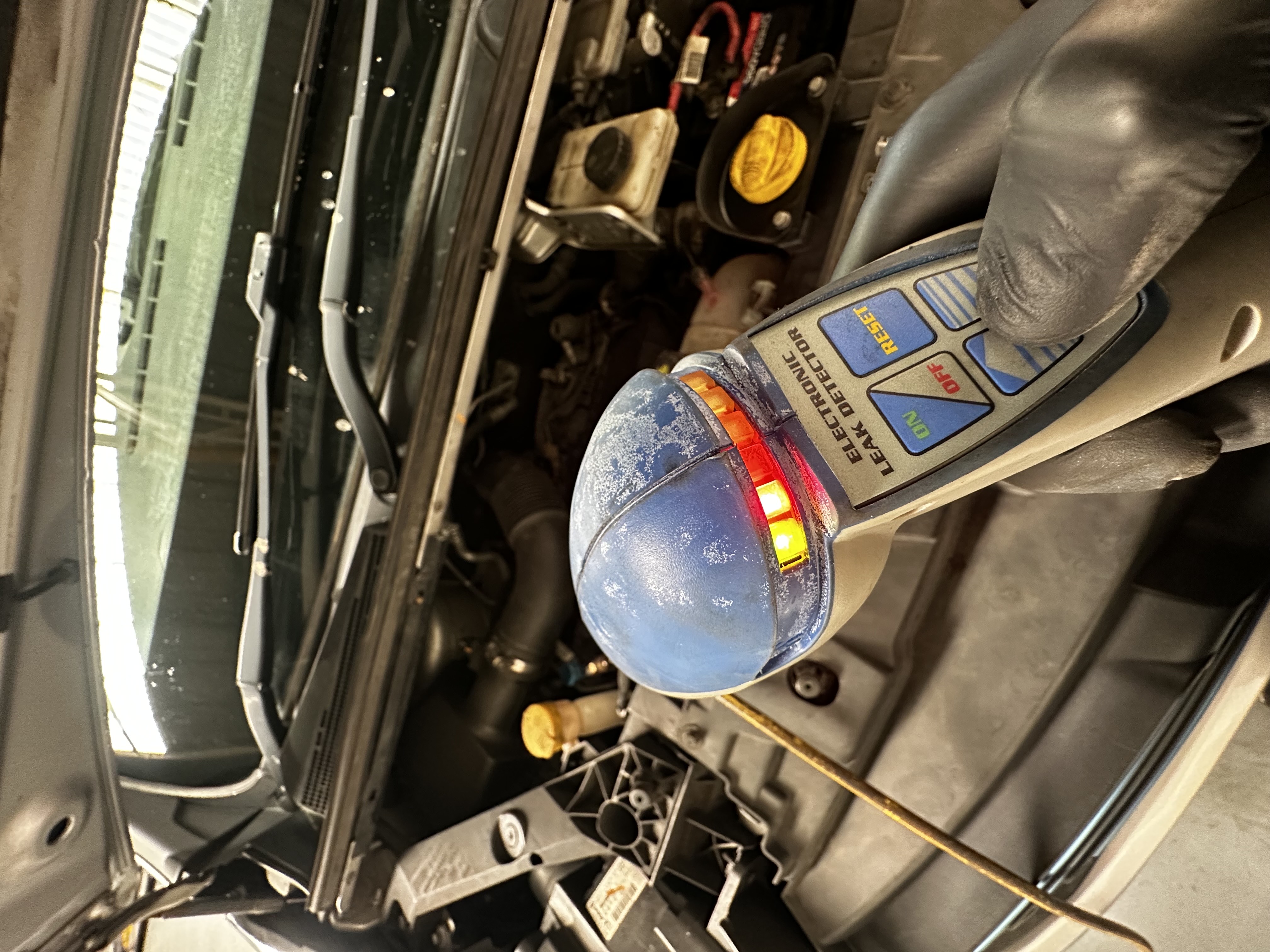
An electronic refrigerant leak detector in use in an engine bay at Shaw’s. The illuminated sensors at the top of the probe indicate a positive refrigerant detection — the device is sensitive enough to detect HFC-134a and HFO-1234yf refrigerant concentrations of a few parts per million. This allows us to scan the full refrigerant circuit, component by component, and identify the exact leak source.
An electronic leak detector uses a heated sensor probe that becomes electrically conductive in the presence of halogenated refrigerant gases (R134a and R1234yf). It does not require dye in the system and detects leaks too small to produce visible dye deposits. The probe is passed slowly around each component of the refrigerant circuit — condenser, evaporator connections, compressor shaft seal, high and low side service port cores, receiver/drier connections, and each pipe union — and triggers an alarm when refrigerant is detected.
R134a and R1234yf
The refrigerant type affects how a leak behaves and how it is detected. R134a (used in most vehicles built before approximately 2016) is more likely to remain as a liquid in areas of lower pressure and is somewhat easier to trace. R1234yf (required in new cars from 2017 in Europe) has a lower boiling point and disperses more quickly from a leak site, which makes some small leaks harder to detect with UV but is still detectable with an electronic sniffer at the source. At Shaw’s, the confirmed pricing is £95 for an R134a recharge and £150 for R1234yf, following a leak check that confirms the system is sealed.
The leak check before the recharge
Shaw’s does not recharge a system without first checking for leaks. Recharging a leaking system sends refrigerant and compressor oil into the atmosphere, costs you money for a repair that will not hold, and can mask a progressive leak in a component that is about to fail more significantly. The leak check is included in the service where a loss of charge is evident, and the findings are explained before any recharge is carried out.
Book an AC diagnosis at Shaw’s →
We check it properly. We explain it properly. We do the job properly. You decide what gets done.
Shaw’s Service Station | Kinmel Bay & Rhyl | 01745 353481