
Battery, Starter and Alternator Testing — What Current Draw Analysis Actually Shows
Slow cranking, a car that won’t start on a cold morning, a warning light after a jump start — these symptoms need testing, not guessing.
A car battery, starter motor and alternator are three separate components in a starting and charging system, and a fault in any one can produce similar symptoms: slow cranking, no start, warning lights, or a battery that goes flat. Testing them individually is the only way to know which is actually causing the problem.
Battery testing — capacity not just voltage
A resting battery voltage of 12.6V looks healthy. But a battery that has been recently charged will show this voltage even if its actual capacity is significantly reduced. Load testing — assessing what the battery can actually deliver under cranking conditions — is a more accurate measure than resting voltage. At Shaw’s, we load-test batteries rather than just checking voltage. A battery that fails under load but reads a healthy resting voltage will continue to cause intermittent no-start problems until it is replaced.
Starter motor current draw
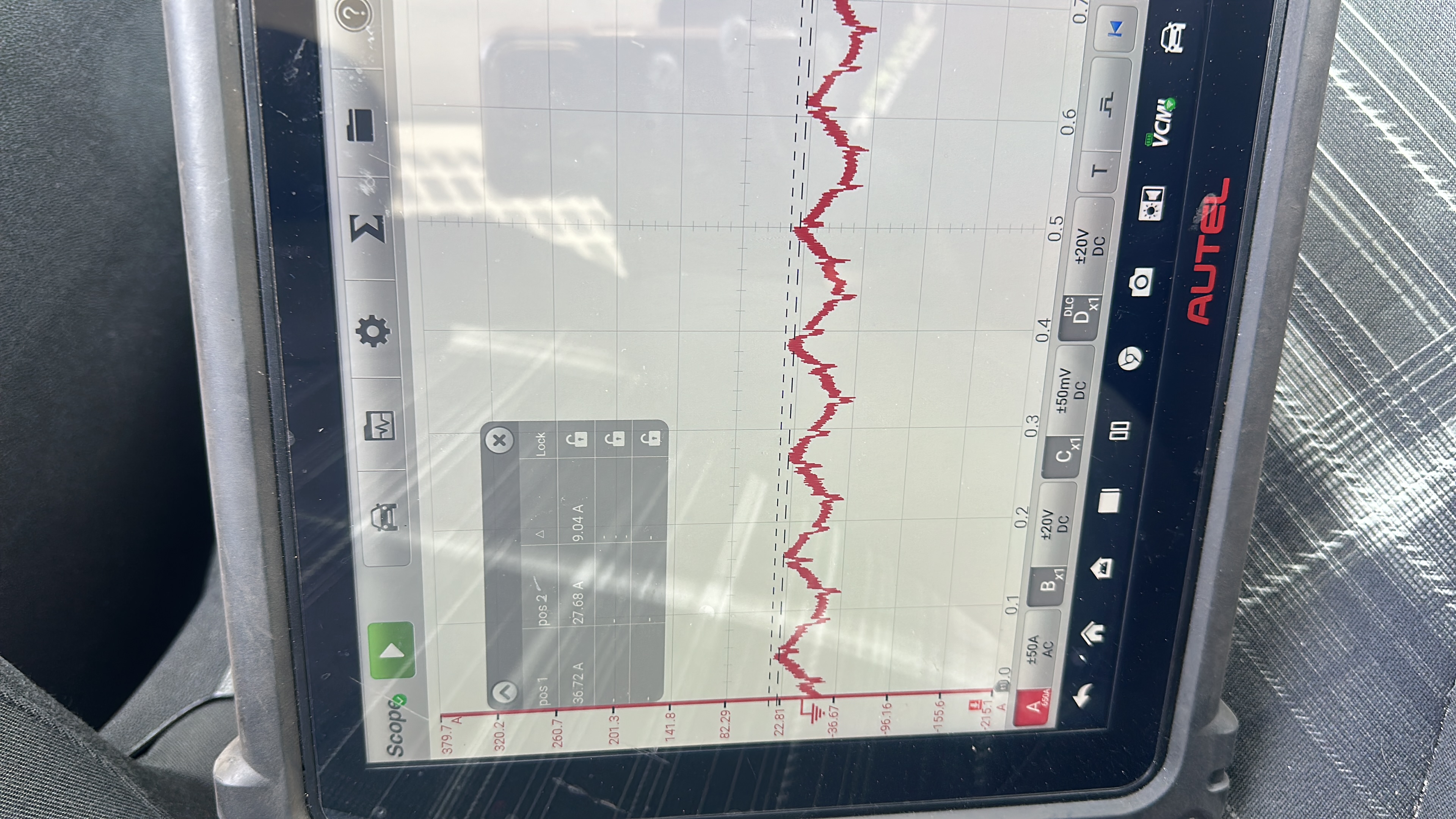
A starter motor draws a measurable amount of current when it operates. The shape of that draw over time tells us whether the starter itself, the battery, or the engine’s mechanical resistance is causing the problem. High current draw with slow cranking indicates mechanical resistance in the engine. Low current draw with slow cranking indicates a battery or connection fault. A normal current draw with intermittent no-start can indicate a dead spot in the starter commutator that only fails occasionally. Current draw analysis captures data across the full cranking event, not just a snapshot.
Alternator output and connections
A healthy alternator produces 13.8–14.7V at the battery with electrical loads on. An alternator undercharging at 12.8V or less gradually drains the battery without triggering a warning until it is nearly flat. We test under realistic load conditions — headlights, heating, AC — rather than at idle with nothing running. We also check battery terminals, earth straps and cable condition as part of any starting system diagnosis, since a high-resistance connection can produce all the symptoms of component failure without any component actually being faulty.
Book a starting system diagnosis at Shaw’s →
We check it properly. We explain it properly. We do the job properly. You decide what gets done.
Shaw’s Service Station | Kinmel Bay & Rhyl | 01745 353481