
ABS Warning Light and Wheel Speed Sensor Faults — How Shaw’s Pinpoints the Problem
An ABS warning light does not always mean the ABS unit has failed. Here is how Shaw’s investigates wheel speed sensor faults before recommending any replacement.
When the ABS warning light comes on, the ABS system has been disabled. The brakes still work — the vehicle will slow and stop — but the anti-lock function that prevents wheel lockup under heavy braking is not available until the fault is resolved. Driving a vehicle with the ABS light on is legal but is a fail item on a future MOT if the fault persists.
What triggers an ABS warning
The ABS system uses wheel speed sensors at each corner of the vehicle to monitor the rotational speed of each wheel individually. When the ABS control module detects that one wheel is decelerating significantly faster than the others during braking — indicating imminent lockup — it modulates brake pressure to that wheel to maintain traction. If a wheel speed sensor fails, produces an incorrect signal, or produces no signal, the ABS module cannot perform this comparison and disables the system.
Common causes of an ABS warning include:
- A failed or failing wheel speed sensor (the most common cause)
- A damaged or corroded tone ring (the toothed ring the sensor reads)
- Damaged wiring between the sensor and the ABS module
- A failed ABS control module (less common and more expensive — often misdiagnosed as the cause)
- Air in the ABS hydraulic unit from a brake bleed that was not performed correctly
Reading the wheel speed signal
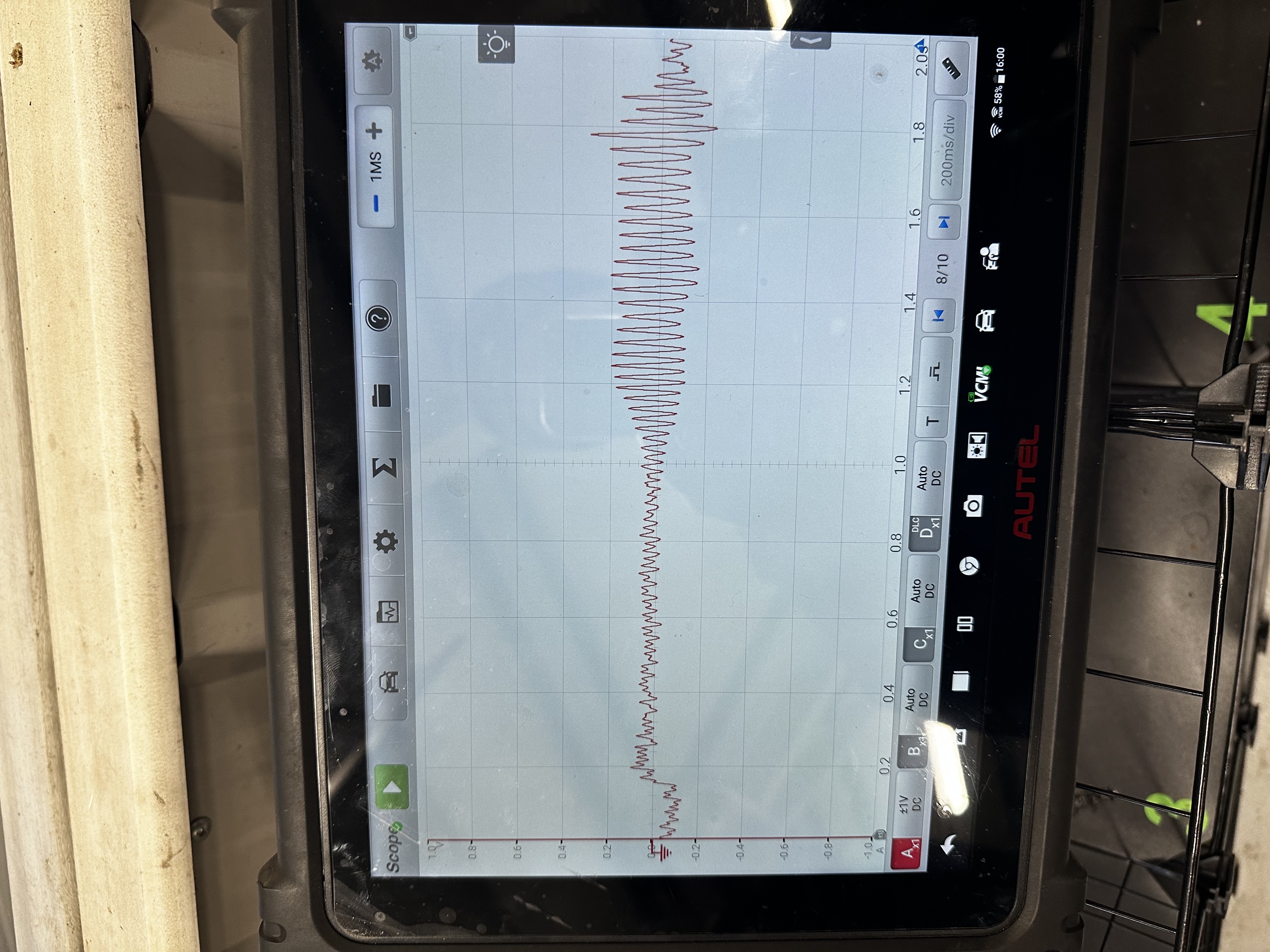
An oscilloscope capture of a wheel speed sensor signal as the wheel accelerates from rest. The amplitude of the alternating signal increases as the wheel speed increases — this is characteristic of a passive (variable reluctance) wheel speed sensor. A damaged or failing sensor produces dropouts, noise, or an asymmetric waveform that a scanner reading live data may only show as an intermittent error value rather than the specific fault.
At Shaw’s, we read the actual waveform from each wheel speed sensor rather than relying solely on fault codes. A scanner tells us which wheel position has stored a fault. The oscilloscope tells us whether the sensor is producing a clean signal, whether the tone ring has a damaged tooth causing a missing pulse once per revolution, or whether the fault is in the wiring between the sensor and the module.
Tone ring damage
A tone ring with a missing, bent or corroded tooth produces one missing pulse per revolution. At slow speeds, this may not trigger a fault code. At higher speeds, the ABS module detects the absent pulse as an apparent deceleration spike and either stores a fault code or briefly activates the ABS on that wheel unnecessarily. The oscilloscope shows this clearly as a repeating dropout in an otherwise clean signal — once per revolution, consistent.
Before replacing the ABS module
ABS module replacement is expensive. In most cases where an ABS warning light is present without any other contributing factors (recent collision, severe corrosion), the fault is in a sensor, its wiring, or its tone ring — not the module. Shaw’s investigates the sensor circuits before recommending module replacement.
Book an ABS diagnosis at Shaw’s →
We check it properly. We explain it properly. We do the job properly. You decide what gets done.
Shaw’s Service Station | Kinmel Bay & Rhyl | 01745 353481